

While the Government of India has by and large remained silent on the Joint military operations conducted by the US-Israeli forces on 28 February against targets in Iran, the bombing and killing of Iran’s supreme leader Ayatollah Khamenei is in the interest of India’s national security. Yet, the situation as it unfolds in the wake of this military action by the US and Israel is not without trouble for India, both at the level of tactics and strategy. In fact, the Islamic revolution of 1979 in Iran is at the heart of the radical Islam (terrorism) which has caused many terror attacks on the Indian soil emanating from Pakistan and funding from Islamic governments. Although killing of Ayatollah Khamenei does not give any direct relief to India in this regard, it will have an impact on the landscape of ideology-based terrorism in the world.
The Islamic revolution in Iran, a Shia Muslim nation, was seen as an existential threat to the Royal family of Saudi Arabia which was in an alliance with the Wahabis’ to rule its Sunni population. The Saudis’ threatened by the Islamic revolution in Iran overreacted to this development and encouraged Jihad (Islamic terrorism. Holy War) in Sunni majority nations including Pakistan. This had a profound impact on India’s national security which has been suffering at the hands of state sponsored terrorism from Pakistan. It is only recently that the West and other countries have come to sympathize with India’s situation and this is so especially after the 2001 September terror attack on the US. Saudi Arabia is directly involved with the US and Israel in this attack on the Iranian leadership, given that the Saudis’ are most threatened by the Iran’s quest for nuclear weapons. According to Saudi Prince Bin Salem, if Iran gets nuclear weapons, then Saudi Arabia will also get nuclear weapons. It very clear, no one is interested in Iran getting a nuclear weapons stockpile, including India. Nuclear weapon will provide Iran the strategic cover (umbrella) to conduct terrorism in middle-east against Israel in particular without any vulnerability to Israels counter attack. This is the situation India is facing against state sponsored terrorism emanating from Pakistan.
India believes both the US and China have assisted Pakistan in acquiring nuclear weapons and have at the strategic level have tied India to the south Asian region. Pakistan has not only reserved its nuclear know-how to itself but has been the biggest proliferator of nuclear technology all over the world. In the recent military operations India has shattered the myth of Pakistan’s nuclear blackmail which was preventing India from taking counter-offensive against terrorist hide outs within Pakistan. On 03 March, Indian Defense Minister Rajnath Singh has issued fresh warning to Pakistan saying that, if Pakistan attempts another terror attack against India, the India will demonstrate its will in a manner that that the world has not seen yet. This threat was issued after terrorist outfits in Pakistan suggested they were planning a major attack by sea route in India.
India’s foreign policy is caught in between the deep sea and devil. Taking a position between the both is almost impossible for India, although many strategic experts in India are for the US and Israeli attack. The situation is far more complex for India as witnessed by the protests by ordinary citizens against the attack in various Indian cities, especially in the state of Jammu Kashmir. India’s huge Muslim population dictates its foreign policy with regard to the Islamic and western (Christian) world. Yet, India’s foreign policy has transformed under the Modi administration and now India is openly in support of Israel in the Middle East and this was very clear in the recent visit by Modi to Israel just two days before the attack on Iran. Although many believe that India was not aware of the timing of the attack, it is very obvious that India’s support was secured during the Modi visit to Israel. India’s interest is more for nuclear weapons in Pakistan, and after Iran it is expected that India in alliance with Israel will target Pakistan’s nuclear weapons. The ongoing military conflict between Pakistan and Afghanistan is directly linked with this strategy. In coming weeks and months, India and Pakistan will engage in armed conflict, and this armed conflict will be a strategic set up to eliminate Pakistan’s nuclear weapons.
Yet another major concern for India is its dependence on oil imports from the gulf region. Any disruption of oil imports and prices adversely effect India’s economic growth and therefore its political stability. Increase in oil prices increase the price of all other related sectors and puts pressure on the administration which has to face elections (state elections) very frequently across India. With India’s strategy to import oil from multiple sources may help India’s situation, but a prolonged conflict in the Gulf region will have a direct impact on India. There is also a large Indian community working and living in the Gulf region adding to India’s concern.
According Retired Admiral Arun Prakash, this military operation against Iran is senseless and lacks any morality or ethics. The central problem is that this war has no particular military objective or political aim and therefore an open-ended war which is very dangerous to pursue. As far an India’s position is concerned, the former Admiral recommends India to take a stand and convey its displeasure to the US.
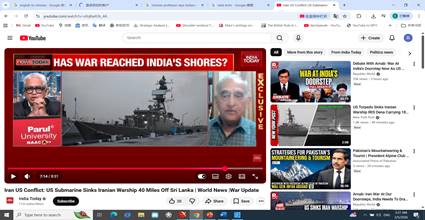
According to American Professor John Meirsheimer, the US is following the Israeli lead in this War. The US does not have any particular aim or objective in mind while carrying out attacks against Iran. The US is fighting Israels War. This view is also echoed in the UK Parliament (opposition MP’s) where it was stated that this war was illegal. But both UK and France are engaging along with Israel and the US as reports suggests. The British Prime Minister made it clear that the UK and the US are operating under the framework of special relations.
According to senior BJP leader and former central Minister Subramanium Swamy, India can no longer stand neutral in this conflict and will have to choose sides between Israel and the US and Russia and China. His recommendation is that India must choose the Israeli and the US side because they are both positive democracies, while Russia and China are not. By not taking a stand in this war, India is hurting its foreign policy and global standing.
On the Whole, this war from a strategic perspective is in the interest of India, but the tactical level it will surely have an impact on India. Hence India is in difficult situation. It will be interesting to see how long can India go without choosing sides in this war.
Dr Rajasimman Sundaram is based at Sichuan International Studies University [Chongqing, China] and associated with The Society for Policy Studies [New Delhi],
